产品挑战
质疑问题定义、设计假设与方案取舍,探索其他可能的方向。
CASE 03 / IGNITE · AI PRACTICE
我不会把 AI 放进设计流程的每一个环节。相比“用 AI 做更多事”,我更关注它能否在关键决策点,为设计增加新的视角、组合和证据。
AI 扩展我提出的问题,最终判断仍由我负责。
CASE 03 / IGNITE · AI PRACTICE
I do not put AI into every stage of the design process. Rather than using it to do more, I focus on whether it can add new perspectives, combinations and evidence at key decision points.
AI expands the questions. I still own the decision.
01 — 我的 AI 工作模型
我不会把每次使用 AI 都当作一场从零开始的对话。不同任务共享同一套产品背景,再依据具体问题调用可复用的 AI 工作流程。
共享产品背景
Ignite · 用户与角色 · 业务规则 · 配置约束 · 现有模式 · 市场差异
质疑问题定义、设计假设与方案取舍,探索其他可能的方向。
检查信息表达、交互逻辑与体验一致性,识别潜在的使用问题。
检验证据是否支持结论,追问其他解释,并明确仍然未知的部分。
建议符合产品背景。
指出的问题成立,但解决方式需要更多背景。
建议与用户需求、证据或产品约束冲突。
AI 广泛探索 → 我筛选 → AI 深入检查 → 我做决定。
01 — My AI Working Model
I do not treat every use of AI as a conversation starting from zero. Different tasks share the same product context, and I use a reusable AI workflow according to the question I need to answer.
Shared Product Context
Ignite · Users & Roles · Business Rules · Configuration Constraints · Existing Patterns · Market Differences
Challenge problem framing, design assumptions and trade-offs, and explore alternative directions.
Review information clarity, interaction logic and experience consistency to identify potential usability issues.
Assess whether evidence supports a conclusion, consider alternative explanations, and make uncertainty explicit.
The recommendation fits the product context.
The issue is valid, but the response needs more context.
The suggestion conflicts with user needs, evidence or product constraints.
AI explores broadly → I filter → AI goes deeper → I decide.
02 — 质疑
不同保险产品可能要求不同数量、不同角色的被保险人。我最初设想用一张卡片承载一个人的信息。
在继续推进之前,我没有让 AI 重新设计界面,而是让它质疑这个方向背后的假设。它指出,按人分卡片隐含着“每个人都能作为相对独立的工作单元”这一前提,但单个人的信息都有效,并不意味着整份申请就满足产品规则。这让我重新检查:单人信息的组织边界,是否也应该是整份申请的校验边界?
AI 原话
“One person per card assumes each person is a reasonably independent unit of work.”
“Every person can be individually valid, while the group still fails a product-level requirement.”
我保留了卡片结构,但将单人信息与整份申请的校验职责分开。
PERSON LEVEL
Information · Local completion
APPLICATION LEVEL
Cross-person rules · Group validation · Overall readiness
A card holds one person’s information, but the application determines whether those people work together.
AI 带来的新视角:它指出了我原本没有明确表达的系统假设,而没有替我设计解决方案。
02 — Challenge
Insurance products may require different numbers and roles of insured people. My initial direction was to give each person a card.
Before moving forward, I asked AI to challenge the assumptions behind this direction rather than redesign the UI. It pointed out that a card for each person assumes each person is a reasonably independent unit of work, yet valid information for every person does not guarantee that the whole application meets product-level requirements. That made me reconsider whether the boundary for organising person-level information should also be the boundary for validating the whole application.
Selected AI Insights
“One person per card assumes each person is a reasonably independent unit of work.”
“Every person can be individually valid, while the group still fails a product-level requirement.”
I kept the card structure, but separated the responsibilities of person-level information and application-level validation.
PERSON LEVEL
Information · Local completion
APPLICATION LEVEL
Cross-person rules · Group validation · Overall readiness
A card holds one person’s information, but the application determines whether those people work together.
What AI added: It surfaced a hidden system assumption instead of designing the solution for me.
03 — 检查
Contest 同时存在于 Admin 和 Agent 两端。单独看,每条流程都可能成立;但当发布状态、参与来源和不同角色的视图组合在一起时,同一条参与规则可能呈现出不一致的结果。现有参与规则要求,Manual sign-up 和 Auto enrollment 最终归一为同一个参与状态 JOINED。
我把这些关系整理成结构化输入,请 AI 检查现有参与规则能否贯穿不同入口和两端视图:Manual sign-up 与 Auto enrollment 是否都归一为 JOINED,Admin 是否避免重复计数,Agent 是否避免再次显示 Sign up。检查同时暴露出一个现有规则无法回答的问题:Admin 在 Agents 加入后取消发布,他们还能否查看进度和结果?
我保留 JOINED 作为两端共同的参与状态,并分别约束 Admin 的计数和 Agent 的可用操作。
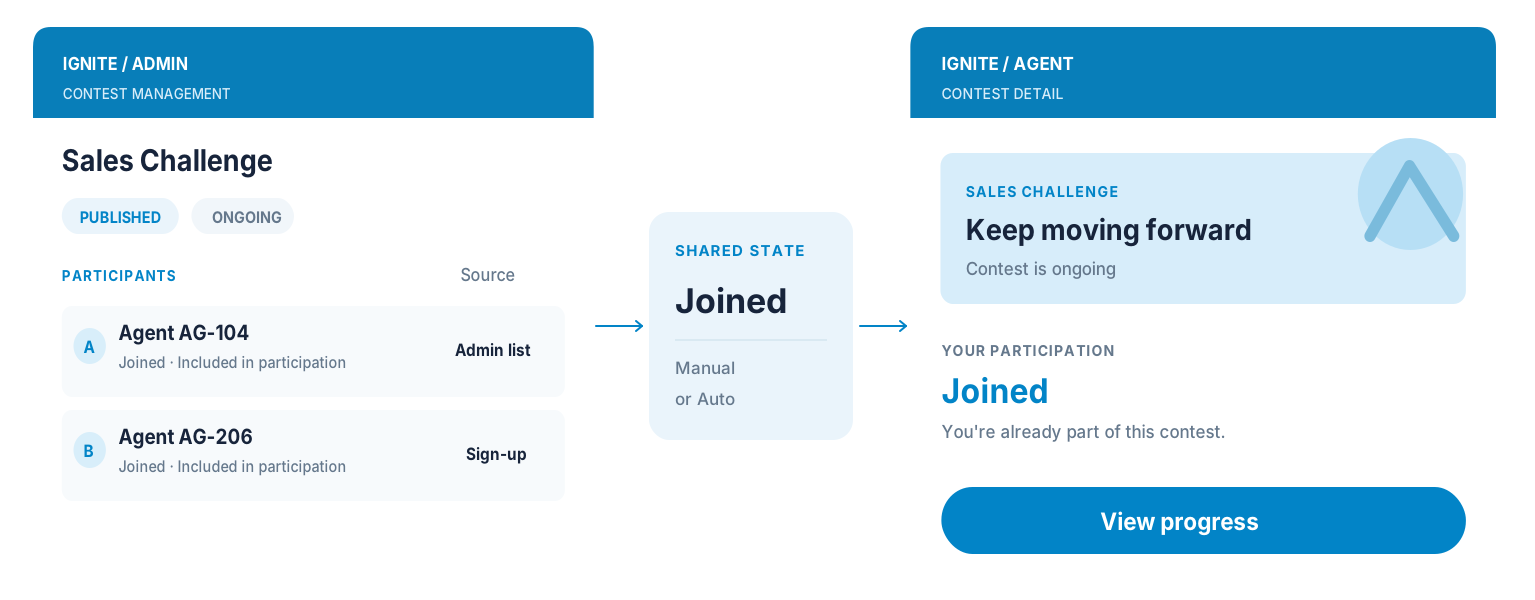
ADMIN
Count each Agent once, regardless of join source.
AGENT
Do not show Sign up again once the Agent has joined.
现有证据不足以回答取消发布后的可见性问题,因此将这条规则标为 NEEDS_CONFIRMATION,等待确认,而不让 AI 补出一条看似合理的业务规则。
AI 带来的新视角:它帮助我检验同一条产品规则在不同角色和使用端之间是否连贯,也让我明确标出证据尚未覆盖的边界。
03 — Check
Contest exists across both Admin and Agent surfaces. Each flow may appear valid on its own, but inconsistencies can emerge when publication state, participation source and role-specific views interact. Under the existing participation rule, Manual sign-up and Auto enrollment resolve to the same state: JOINED.
I structured these relationships as input for AI to check whether the existing participation rule remained coherent across entry points and surfaces: whether Manual sign-up and Auto enrollment both resolved to JOINED, whether Admin avoided double-counting Agents, and whether the Agent surface avoided showing Sign up again. The check also exposed a question the existing rules could not answer: if Admin unpublishes after Agents join, can they still see progress and results?
I kept JOINED as the shared participation state for both surfaces, with corresponding rules for Admin counts and the Agent’s available actions.
ADMIN
Count each Agent once, regardless of join source.
AGENT
Do not show Sign up again once the Agent has joined.
The available evidence was insufficient to resolve visibility after unpublishing, so I marked the rule NEEDS_CONFIRMATION for follow-up rather than letting AI supply a plausible-sounding business rule.
What AI added: AI helped me test whether one product rule stayed coherent across roles and surfaces, while making the evidence boundary explicit when the rule was unknown.
04 — 衡量
Google / Apple 登录上线后,可以追踪许多事件,包括 binding · login · registration · unbinding · password setup。但一个事件可以被统计,并不意味着它足以代表用户价值。因此,我把问题从“应该追踪什么?”改为“每个事件究竟证明了什么?”
“Successful binding is a setup milestone, not proof of adoption.”
这让我把衡量模型分成三个层级:先看用户能否完成连接,再看连接是否帮助他们进入正确且可用的 Ignite 账户,最后看他们是否会在下一次登录机会中再次选择它。
Can users connect it?
Does it actually get them into the correct, usable Ignite account?
Do they choose it again?
这里有一个重要边界:持续保持登录的用户还没有遇到下一次登录机会,不能因此被算作没有再次采用。
Users who stay signed in haven’t had another login opportunity — don’t count them as non-adopters.
AI 带来的新视角:它帮助我区分“我们能够统计什么”和“什么真正代表用户价值”。
04 — Measure
After Google / Apple authentication launched, we could track many events, including binding · login · registration · unbinding · password setup. But an event being countable does not mean it represents user value. I changed the question from “What should we track?” to “What does each event actually prove?”
“Successful binding is a setup milestone, not proof of adoption.”
This led me to organise the measurement model into three levels: whether users can connect an account, whether that connection gets them into the correct and usable Ignite account, and whether they choose it again at their next login opportunity.
Can users connect it?
Does it actually get them into the correct, usable Ignite account?
Do they choose it again?
There is an important boundary: users who remain signed in have not yet had another opportunity to log in, so they should not be treated as non-adopters.
Users who stay signed in haven’t had another login opportunity — don’t count them as non-adopters.
What AI added: It helped me separate what we could count from what actually represented user value.
05 — 一种实践,三个决策点
确定方向之前,我用 AI 质疑假设;设计成形之后,用它检查体验在不同状态和角色之间是否连贯;评估效果之前,用它追问证据究竟能证明什么。
质疑——我正在假设什么?
检查——什么可能出错?
衡量——这些证据究竟证明了什么?
这三个决策点最终都回到同一条路径:
产品背景 → AI 视角 → 设计师判断
我不需要在每一个设计步骤里使用 AI。我更关心的是,在哪些决策点,多一个视角能够真正提高判断质量。
05 — One Practice, Three Decision Points
Before committing to a direction, I use AI to challenge assumptions. Once a design has taken shape, I use it to check whether the experience remains coherent across roles and states. Before evaluating success, I use it to question what the evidence can actually prove.
CHALLENGE · What am I assuming?
CHECK · What might break?
MEASURE · What does the evidence actually prove?
All three decision points return to the same path:
Product Context → AI Perspective → Designer Judgment
I do not need AI at every step of the design process. I care more about identifying the decision points where another perspective can genuinely improve my judgment.
AI 对我的最大价值,不是让我生成更多页面。它让我能够更早质疑假设、检查更多可能的组合,也更严格地追问一项证据到底证明了什么。
但什么值得改变、什么应该保留,以及什么不能交给 AI 决定,仍然是设计师的责任。
The greatest value of AI for me is not generating more screens. It helps me challenge assumptions earlier, examine more possible combinations, and ask more rigorously what a piece of evidence actually proves.
But deciding what is worth changing, what should stay, and what AI should not decide remains the designer’s responsibility.